Saturday, September 10, 2016

About That Basket...

It's Saturday morning and I'm evaluating our past week. It was good, in fact very good. But one thing keeps nagging me and that is... we don't have a Morning Basket (as I sarcastically stated in a previous blogpost.)

But I feel left out. Am I doing our homeschool a disfavor? I often go back and read about one of my favorite blogger's basket. Sigh... Why can't I get this awesome morning time basket thing together?

Now, after a couple of cups of coffee I realize that I've been comparing again, a debilitating habit of mine that I hate to admit. The real deal is that we do have a Morning Basket; it's just different. It's unique to us; it's what we need and what we treasure. 


I'm a morning freak and a running fanatic. I get up around 5:00 a.m., drink a cup of Joe, read a little, chat with hubby, and then head out the door. I'm plugged into either an audiobook (I recently finished Hamilton by Ron Chernow) or a podcast. My favorites are The Thomas Jefferson Hour and Hardcore History.


I get back home at 7:45 and do it again but differently. This time Grace, Mary, and Pepper tag along. By 8:00 we are all up and out, waking up together as we talk about all sorts of things.


For example, this week we...

  • Discussed Kepler's Three Laws of Planetary Motion.
  • Laughed about how Pepper's tail sticks straight up and looks like an exclamation mark.
  • Listened to Grace practice her monologs for a theater audition that happened on Friday. (FYI. She aced it.)
  • Learned about St. Augustine as Mary shared the knowledge gained from her Veritas Press self-paced history course.
  • Listed all the songs from Alexander Hamilton in their correct order. (We're slightly obsessed.)
  • Talked about ways for us to reach out to and prayed for a struggling family that we know.
  • Took pictures to use for our nature journaling and observed God's amazing creation. 
  • Talked about what Grace heard in Sunday School from her middle school friends about girl fights and how to react to these issues as a child of God.
  • Discussed the fate of the Lakota Indians concerning the North Dakota Pipeline crisis and how badly white America has historically treated our Native Americans. 
  • Pointed out how the use of ambiguous and vague words can lead to verbal disagreements.
  • Teared up (well I did) as I shared my favorite Bible verse: "And when I wake up, You are still with me." Psalm 139:18


We need this time to reconnect before our school day begins and I love taking this time to pull together what we're learning and make it relevant to our lives. 

So our basket may not fit into what would be considered a typical Morning Time routine but it works for us and that's all that matters.

In the words of Dr. Seuss, "Why fit in when you were born to stand out?"

Melanie


Friday, August 26, 2016

Diving in...


Here we are launching year eight with Classical Conversations. I suppose I should be a pro by now. Yeah... right. Because my habits follow those of most homeschooling moms, I've spent more than the necessary amount of time figuring out the nuts and bolts of teaching our girls this year. In other words, I've been wrestling with the issue of whether I can broaden their minds without losing mine in the process. Hmmm. I think I've probably already crossed over that line. 


Mentioning the desire to keep as much of my sanity intact as possible compels me to chime in about the Morning Basket trend. This is the attractive habit of sharing inspirational readings, gazing upon lovely art, and discussing inspiring thoughts with each other first thing in the morning. Well, I've finally realized that one of us (I won't name her, but she just turned thirteen this summer) is not especially warm and fuzzy upon wakening, so keeping my basket to myself as we begin the day is the safest and the wisest morning ritual at this house. But I digress.


This morning my ten year old daughter christens her seventh year of CC alongside her small, beloved, group of friends as she begins her maiden voyage in the Masters class. Whoopee! One thing I know for sure is that the Foundations and Challenge programs have provided our homeschool with necessary structure and abundant knowledge. I've tried managing the beast called homeschooling without this guidance and community. Talk about losing my mind! I quickly returned with my tail between my legs. 


Now that we're at the halfway mark in our educational journey, I can see that obtaining knowledge at the grammar stage is sort of like riding waves aboard a sailboat. Memorizing the facts the first time around makes for a beautiful and eye opening journey with only the occasional rough water. It's not too difficult to stay pretty dry. Yet at some point the water becomes too tempting to resist. That's where we are now. This girl is longing to jump into the sea and swim. She's ready to get soaked to the bone.


I'm a sucker for books and it shows. Our bookshelves are overflowing with every kind of classical curriculum I can get my hot hands on, always trying to find the next best thing. But seriously... enough is enough. This year I'm forcing myself to employ the resources we already own as I coach my daughter and set some expectations. I have to keep myself coming back to the fact that there's way more information in this world than I could ever expose our children to and that my role is to teach them the skills that they need to navigate this Sea of Knowledge by themselves. But I also know myself. I need a plan to keep me focused on our goals; to keep us headed toward the horizon.


My plan is to use CC's Cycle 2 Sea of Knowledge as the diving board for my daughter's plunge into her own dialectical and rhetorical ocean. Navigating these waters will definitely be daunting at times (maybe more often than I'm prepared for), but with the correct equipment, instruction, and guidance it certainly will be possible. I hope.


I've compiled a list of the skills that I'm expecting my daughter to practice this semester along with the sources she'll use to accomplish this. The CC memory work serves as a means to perfect her grammar skills while the added curriculum provides the substance necessary to develop her dialectic and rhetoric skills. 


Grammar


Dialectic
  • Complete several math lessons weekly and engage (with me) in conversation about math problems and concepts each day.
  • Play math games.
  • Parse and diagram sentences. LOE/Essentials
  • Explore 1st declension nouns and 1st conjugation verbs. Lively Latin
  • Create key word outlines. IEW
  • Read and narrate living books about the people of Cycle 2's history including various scientists, composers, and artists. Ambleside, Living Books, Local library  
  • Read, listen to, and narrate stories about the Middle Ages. The Story of the World
  • Relate historic people and events to each other by placing them on a timeline. 
  • Connect history to world geography by placing locations on a world map.
  • Study the science of astronomy by way of narration, note taking, and hands-on projects. Guide to Astronomy
  • Listen to the music of great musicians. Classics for Kids


Rhetoric

  • Explain several math problems to me each week.
  • Write a structurally sound paragraph from a key word outline.
  • Incorporate various stylistic techniques into the writing assignments.
  • Compose sentences made up of the different sentences structures, patterns, and purposes.
  • Use proper grammar and appropriate parts of speech when speaking and writing.
  • Exhibit some understanding of planetary motion. 
  • Narrate the major events and historic people of the Middle Ages. Veritas Press 
  • Participate in class presentations concentrating on public skills.
  • Create works of art that relate to famous artists. 
  • Observe nature and keep a nature journal.

I intend to refer to this list often letting it act as her lifejacket and my buoy. Even though I want my daughter to wholeheartedly dive into the water, I certainly will make sure that she doesn't drown. She'll probably need to stick some water wings on here and there but then again so will I! We'll navigate this Sea of Knowledge together one stroke at a time. Somewhere way across that ocean is a beach full of wonderful secrets just waiting for her to unfold. 


And where will I be eight years from now? Ahhh... My crystal ball reveals a sweet scene. Through a dreamy fog, I see my husband and myself relaxing in the sun, reading mindless novels while sipping chilled Chardonnay topped off with those cute little umbrellas. We'll hopefully be basking in the warm thoughts of a job well done. 


Seize each day.

Monday, August 1, 2016

Where We'd Rather Be


This year I'm trying to be more intentional with my schooling agenda. I'm looking at our curriculum and streamlining it to cover what we need to accomplish and what we are really going to do. I'm figuring out where we'd rather be. I have a plan.

First, I did an assessment of my daughter's present skills grouped into the trivium stages of grammar, dialectic, and rhetoric.  I find that this breaks it all down for me so that I can focus on skills rather than content; become empowered instead of overwhelmed. I'll revisit this list at the end of 18 weeks and see where she is at that time.** Next, I outlined the skills she'll be working on this semester and the curriculum (content) she will use to achieve those skills. I'll also return to these in four months, reevaluate, and make adjustments.


I'm planning to totally embrace CC's Challenge B curriculum partly because I'm directing the class but mostly and more importantly because it's an unbelievable program. The material is so engaging and relevant that I only wish I had had the opportunity to be a part of it when I was in 8th grade... many, many years ago. Thankfully, I'm blessed to be a part of Challenge now. Better late than never.

This is what we're planning to accomplish 1st semester 2016 with Grace (and hopefully, with grace.) I've accentuated the skills she'll work on in order to keep them foremost in my mind. By daily referring to this list, I intend to stay on track as we venture into this territory called Challenge B.


Grammar (Latin) Henle First Year Latin
Grammar 
* Pay attention to detail.
  • Decline and conjugate new words
  • Make grammar and vocabulary flash cards to memorize.
  • Recognize Latin words, roots, and derivatives in all subjects.
Dialectic
* Engage in dialogue by asking questions, defining terms, comparing ideas, and recognizing patterns and rules.
  • Parse from Latin to English and English to Latin.
  • Apply Latin structure to Logic and English.
  • Discuss/practice vocabulary and grammar in class utilizing the Five Common Topics.
Rhetoric
*Embrace the study of Latin as a means to begin in conversation with all of mankind.
  • Develop and practice the skills required to learn any language.
  • Participate positively in classroom discussions.
  • Come to class prepared to discuss and present concepts from homework.
  • Be able to recognize and express the integration of Latin in the other strands.

Logic (Math) Saxon Algebra 1/2
Grammar
* Read the alphabet (symbols), memorize the proper vocabulary (facts), and internalize the structural rules (laws and operations).
  • Continue to memorize math formulas, laws, and facts.
  • Make flashcards of terms, laws, and formulas to help with memorization.
  • Complete a math lesson/test each day.
Dialectic
* Ask questions that lead to clarity about how math works and how to use numbers in relationship to one another. What am I being asked to find? What information am I being given? What operations or relationships help me rightly relate the information given?
  • Improve speed and accuracy while logically applying math laws to basic algorithms. 
  • Demonstrate all the math work.
  • Discuss concepts and math problems by way of the Five Common Topics.
Rhetoric
* Develop an appreciation for math equations because they balance, because they give us a mystery to talk about, and because it reflects the nature of our Creator.
  • Manipulate and use the text to teach self.
  • Explain math problems.
  • Come to class with work completed, ready to discuss and present.
  • Recognize and express how math exhibits itself in all subjects.

Rhetoric (Logic) Introductory Logic
Grammar
* Memorize precise definitions.
  • Memorize the vocabulary of Formal Logic.
  • Make flashcards of Logic terms.
  • Memorize syllogism rules and fallacies.
Dialectic
* Sharpen the skills of sound reasoning, of good discernment, of thorough analysis of ideas and thoughts, and of correct argument. 
  • Discuss the skills of clear reasoning and critical thinking working towards understanding.
  • Order information into usable form.
  • Participate in class discussions.
Rhetoric
* Consider ideas thoughtfully and use those ideas to build greater understanding of the world and their place in it.
  • Come to class prepared to present concepts.
  • Identify Logic in the other strands (and in life.)

Debate (Current Events) News Articles
Grammar
* Define terms related to specific events.
  • Define and recognize bias.
  • Identify reliable news sources.
  • Define various current events topics.
Dialectic
*Exhibit curiosity by asking good questions.
  • Formulate questions by way of the Five Common Topics: Definition, Comparison, Circumstance, Relationship, and Authority.
  • Organize facts into a persuasive format.
  • Participate in class discussions.
  • Read news articles critically.
Rhetoric
* Join in the classical conversations of mankind, seek and discover knowledge, and promote freedom and justice.
  • Discuss controversial issues with passion not emotion.
  • Defend a premise with supporting facts.
  • Present persuasively in class.
  • Connect current events with past historical events both secular and biblical.

Exposition and Composition (Literature) The Lost Tools of Writing
Grammar
* Define the parameters of each assignment.
  • Read each assigned book.
  • Compile a list of unfamiliar words and their definitions.
  • Practice the mechanics for writing an essay. 
  • Plot the history and geography from the literature on a timeline.
Dialectic
* Analyze and compare the work of excellent writers through a rich literary environment.
  • Narrate each assigned reading.
  • Create sentences using the new vocabulary words correctly.
  • Develop thesis statements.
  • Use the Canons of Invention and Arrangement to create outlines.
  • Actively participate in class discussions.
  • Identify LTOW elements in the essays of peers.
Rhetoric
* Develop speaking, writing, and thinking techniques by exposure to the greatest thoughts expressed with the finest, most apt words.
  • Write persuasive essays with proper technique and style utilizing the Canon of Elocution.
  • Be able to discuss cause and effect and antecedent and consequence.
  • Present in class utilizing the Canons of Memoria and Pronuntiatio. 
  • Evaluate self and peers by the method of assessing to bless. Point out one thing done well AND what could be done differently the next time to make the presentation better.

Research (History of Science and Science Fair) Independent research
Grammar
* Accumulate definitions which will become the pegs on which richer definitions are hung.
  • Memorize the Scientific Method.
  • Take notes.
  • Plot scientists on the timeline.
  • Place the geography associated with each scientists on the map.
  • Memorize timeline.
Dialectic
* Take the facts of the natural world and ask questions about those facts, seeking to understand those facts by defining, comparing, and relating them to each other.
  • Organize research into a fused outline.
  • Follow the instructions in the guide to complete each assignment.
  • Use time well to complete the science fair project. Plan ahead and stay on schedule.
  • Participate in class discussions using the Five Common Topics.
Rhetoric
* Realize the potential for incorrect conclusions which can lead into further dialogue that continually defines, compares, relates, and considers circumstances and authority either to build further upon that which has already been discovered or transcends and corrects that which has been hypothesized incorrectly.
  • Write a concise five paragraph expository essay.
  • Present in class using appropriate public speaking skills.
  • Reflect on how science builds on past hypotheses and discoveries.
  • Be confident about the the science fair project and be prepared to answers questions.
  • Evaluate self and peers by "assess to bless".


As I finish this outline, my mind is busy thinking about all the adventures coming our way this semester. Together, my daughter and I are beginning a journey along the road towards where we'd rather be. There may be some rough spots ahead but the ride should be thrilling!

Melanie


** Diane Lockman's Trivium Mastery Map available through her Mom's Course.
* The Question by Leigh Bortons. This book is fantastic!


http://ihomeschoolnetwork.com/curriculum-week-2016/


Sunday, July 24, 2016

Counting My Blessings


This morning, I revisited my husband's blog from our 2007 China trip. I'm blown away by the various ways that God creates families. Sometimes parents travel to the other side of the world to bring their children home. Come take a stroll with us down memory lane...
 http://rbjadoption.blogspot.com/

Saturday, July 16, 2016

Looking Around Through Nature's Lens

I love history; any era, any country, any culture, any person. This summer I got a boy crush on Alexander Hamilton. (Don't worry. I'm not going to write about him again.) But his fantastical story did encourage me to look around and take in some of our local history that happened pretty much right smack dab in our backyard.

Early in the summer, I excitedly signed my family up to take part in a summer nature exchange. We began collecting, pressing, and drying a sampling of assorted area wildflowers. I'm somewhat obsessive about incorporating as much learning as possible into our daily activities. (We homeschool, remember?) But this time I was in desperate need of some inspiration in order to do something a little bit different; to make this project more interesting; to give it a theme. So we stopped by our local visitor's center, picked up some brochures about our region planning to send them on to our nature exchange pals in Kansas along with some crafty items we created. One of these pamphlets lays out the saga of a little-known battle that took place right here in our little ole' town. Ah-ha! I had found my angle.


(Before you read any further, my apologies to all you history and nature experts. I'm not in your club. My goal is to engage our children to look around, to be observant, and to be curious about their world. I'm doing the best I can.)


Lewisburg, West (by God) Virginia. Greenbrier County. Washington Street. Our house is situated right on the battleground of The Battle of Lewisburg which took place for all of one hour on May 23, 1862. Let me tell you a tale of yesterday framed by the natural beauty of today's Greenbrier Valley.

In 1862 Lewisburg, Virginia was a quiet, sleepy, little town with a population of 800 people, consisting mainly of Southern sympathizers. (I believe the population today is only around 4000.) On May 21, Union officer Colonel George Crook and his 3rd Provisional Ohio Brigade set up camp with the knowledge that rebel troops were going to be moving into Lewisburg. Colonel Crook's claim to fame was that he captured the Apache Chief Geronimo. His battalion, made up of about 1400 troops from Ohio, was encamped on top of a hill to the west of the city.

Today this area is home to our beautiful Greenbrier County Public Library. A well-marked path leads from the library all the way to our new elementary school lined with White Heath Aster, Honey Suckle, White Clover, Fleabane, various grasses, and yummy blackberries all along the way. The Union had a great vantage point.


He placed his sentry about three miles to the east to guard the bridge at Caldwell and to watch for the approaching enemy.


The bridge spans our lovely Greenbrier River which is still at a high level due to our horrendous recent flooding. Its banks display American Chestnut trees, Red Maples, Purple Aster, and abundant Queen Anne's Lace. This stately historic home pictured below has been flooded numerous times and now is once again waterlogged. 


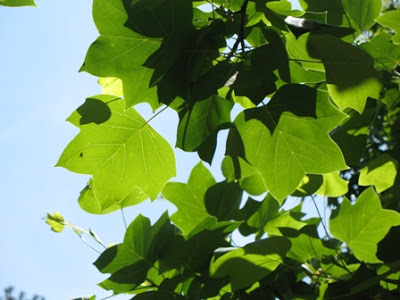
One of our favorite activities has always been riding bikes on the Greenbrier River Trail which we enter at this location. I think my favorite tree leaf here belongs to the American Tulip also known as the Tulip Poplar. Today we ventured onto the trail for a little look-see. We didn't get very far before confronted with this jarring abyss.


But Crook's guards couldn't compete with the approaching Confederates. In the severely early hours of May 23, the rebels led by Brigadier General Henry Heth seized the bridge, captured the Union sentry, and trudged into Lewisburg. This force, made up of about 2300 Virginians, was confident and sure of victory. They had yet to experience defeat, even boasting how they were going to visit the ladies of Lewisburg once they chased the Yankees out of town. They thought that they were going to stage a surprise attack, but luckily Colonel Crook was alerted. Although this battle was the first for Crook's troops, they were up for the task. They were out-manned and out-armed, yet they were ready to take on the rebel troops.

One section of the rebel Virginia troops set up camp to the east of town along what is now Dwyer Lane.


We spend lots of time at this spot. It is now home to three baseball fields, one football field, a track, playground, skate park, and trees just waiting to be climbed. This site is full of Pitch Pine, Virginia Pine, Hemlock, and Sycamore trees. Years ago my now adult children loved to hang out in these trees. At that moment in time, I would have never imagined that we'd have two more children scrambling up these branches. 


More Virginia infantry made their way to the right to hold in a field behind what is now the West Virginia School of Osteopathic Medicine. Here they waited for their orders.


WVSOM is one of the leading medical schools in our nation. It's original building housed the Greenbrier Military School from 1812 to 1972. I wonder if any of these White Oak and Black Locust trees had grandparents standing here back then. In 1974, this osteopathic school began with a class of 36 students. Today the school is a thriving part of our community and has an enrollment of approximately 800 students. The clock tower shown below is a focal point of a brand new student union building.


Finally, the 8th Virginia Calvary and Artillery (canons) were stationed in another field to the left overlooking the town.


This property is now the lovely backyard of The General Lewis Inn, dating back to 1834. It has 25 rooms and specializes in weddings and special events. (And it's three houses up the street from our house.)


At 5:00 a.m. General Heth was ready to give it to those damn yankees. He started the bombardment but misjudged the range of fire. Instead of reaching the Union camp, a canon ball fell short killing one of his own men and hitting the John Wesley Methodist Church.


This lovely historic church is still very active today. I know because it is right behind my house!


The Confederates finally figured out the shooting range and began an all out attack. Union troops quickly assembled at the bottom of Foster Street and pushed their way towards the rebels who had so rudely awakened them.


The lawn of Carnegie Hall occupies this location. It is the site of various performances, educational activities, and outdoor concerts. An unbelievably gorgeous Gingko Tree is its centerpiece. We're mesmerized by this tree with its fan-shaped leaves especially in the fall. Amazingly, all the leaves drop over the span of about one day creating a ground cover of glimmering gold.


Our lovely daughter and her sweet friends enjoying an evening on the lawn at an Ivy Terrace concert. Aren't they adorable?


Another group of Cook's men assembled at the Greenbrier County Courthouse. They advanced uphill to meet up with the right side of the Virginian forces. Although inexperienced, the Union soldiers fought like veterans and the rebels began "falling like ten pins in a bowling alley."


Our courthouse has been in constant use since it was built. My lawyer husband is a regular there.


The 36th and the 44th Ohio troops were charging up the hill on the left and on the right and now the the 2nd (West) Virginia Union Cavalry joined them making its way right up the center of Lewisburg. They were boldly heading up Washington Street straight into the hub of the Confederates.


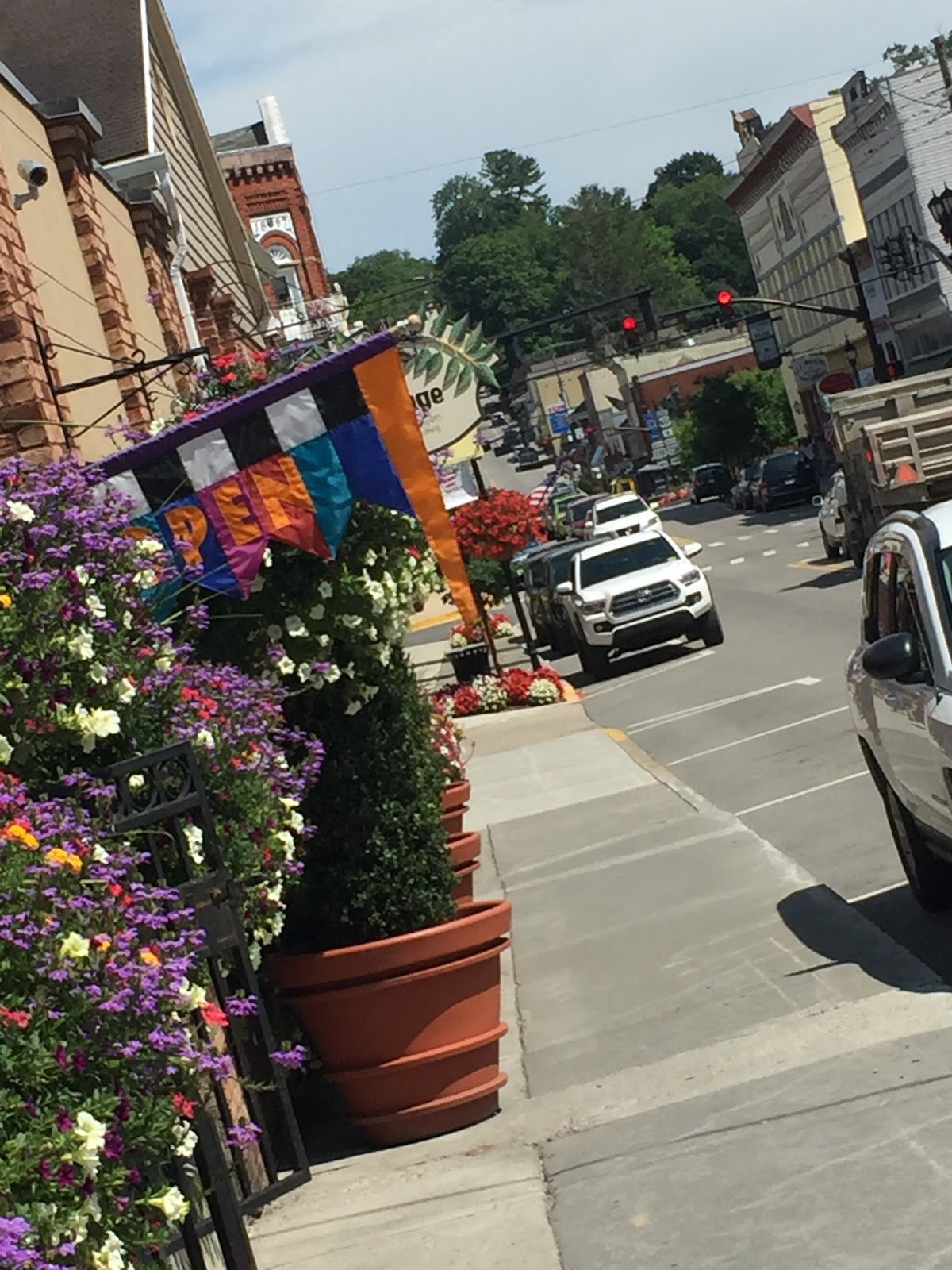
Washington Street is the heart of our downtown. Actually, it IS our downtown brimming with trendy shops and upscale restaurants. I adore the flowers outside of Del Sol. Our local merchants take pride in creating a delightful street overflowing with curb appeal.


When Colonel Crook's men reached the crest of the hill where the General Lewis Inn stands, they moved in and overran the artillery. They then crossed over to a nearby field and opened fire on the Ohio battalion. The rebels ran despite strong efforts from some of their officers to rally the troops.


This field is now a quiet little neighborhood. The homes are modest, but all are landscaped with well cared for lawns and gardens. We walk this neighborhood daily. Hey...that's our neighborhood!


At this point, Heth gave up and retreated back across the bridge on which he and his troops passed over when they so confidently marched into Lewisburg. Now they were running. The defeated Confederates burned the bridge upon their exit and fled.

Heth's casualties were far greater than those of Crook's. 80 of his soldiers were dead, 100 were wounded, and 157 were taken prisoner. The Union fared much better. 13 were killed, 53 were wounded, and 7 were missing. Colonel Crook wouldn't allow the rebel sympathizing citizens of Lewisburg to bury the dead Confederate soldiers or have any burial ceremonies. The bodies were placed in a trench in the churchyard of the Old Stone Church.


This historic church and its graveyard are poplar attractions. In the fall, it is haunted by ghost tours led by guides full of tantalizing tales about its inhabitants. It is framed by huge Hemlock trees, Eastern Red Cedars, and White Spruce.


At some time after the war, these Confederate remains were moved to the site of the Union encampment and placed in a cross shaped mound on top of the hill.


95 unidentified Confederate soldiers lie here today under huge Pine, Locust, and Maple trees. It's a lovely,  peaceful setting.


The wounded from both camps were cared for in several of Lewisburg's public buildings which were used as hospitals. With the battle over, every soldier was kindly nursed no matter where their loyalties lay.


Three of these buildings are the John Wesley Methodist Church (the one the canon ball hit), Old Stone Presbyterian Church (with the dead soldiers beside it), and the old Greenbrier County Library. This building served as our county's library until 2007 when our present beautiful library opened.


So, this is the end of the story about an insignificant Civil War battle which took place in a tranquil Southern town that is surrounded by fairly typical natural beauty. Yet, when I take the time to look around, I realize that it's all the little, seemingly simple things that make where we live and what we learn about all extremely significant.


Our home stands in the shade of a giant Sugar Maple only steps away from the very spot of this Union victory.  Oh, what stories this old tree could tell...